
Title: Homage to Catalonia
Author: George Orwell
Genre: Fiction, Historical
ISBN: 0141183055
# of Pages: 248
Publisher: Penguin Books;1938
Began Reading: January 30th, 2006
Finished Reading: Feb. 4th, 2006
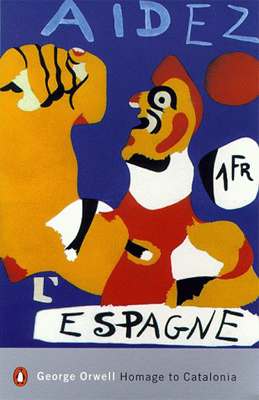
In Barcelona, my days fell into a pattern. I would wake up at 6am and go to Starbucks for 6:45. There after being online for 2 hours, I would return home and change. Sometimes Painter J, the person I was staying with, would be home and we may chit chat before I left for either a guided tour or sightseeing. That lasted till 2pm for which I would return to the studio and meet J again for lunch... almost everyday for over 3 weeks. One of these same mornings, as I was returning to the studio in hopes of eating rabbit for lunch, I realized that I was early and decided to puruse the bookstore shelves. Not expecting to find anything of interest - it is Barcelona after all- the covers of the books and the familiarity of a 'face' well loved was enough. Then an odd cover, what looked to be a rooster, caught my eye. I unconsciously went to pick it up. Seeing the title and the author and the language, the purchase was a done deal. That's how and where I ended up reading Homage to Catalonia.
The Incident: Our main character, a British gentleman, finds himself in Barcelona with his wife at the Eve of the Spanish Civil War - the fight between Franco and the Republicans/Loyalists. Our narrator, overcome with the sensation of having entered into an' era of equality & freedom' (page 4), joins forces with the latter group in the fight against monarchy and totalitarian rule. What follows is an account of war - unorganized, cold, smelly and quit boring to those who fight it. As our English eye-witness tells it, there came a point where there was uncertainty about who was what and where. Though he, till the very end, defends the Loyalists and their cause, he acknowledges the impossibility of complete horizontal rule. "If you wanted to slap the general commanding the division on the back and ask him for a cigarette, you could do so, and no one thought it curious. In theory at any rate each militia was a democracy and not a hierarchy." (Page 26) His peers are his superiors and vice versa. There is no authority nor organization - simply put they fight - or try to - a common enemy. With that, comes the insight Orwell brings to the Catalonia way of life. When asking a Spaniard for a cigarette they give the entire pack, he recounts.
Comments: It was a good read to be sure though the language was somewhat dense. This is not so fictitious as Animal Farm or 1984. The account is very much like a memoir thus it took some adapting to. Never thought that a gendre had such an effect on my frame of mind while reading but it did. Of course, the experience and knowledge gained from the text enriched my trip and experience there. Top that off with sharing the text with J as he related his vivid memories of the Civil War in return.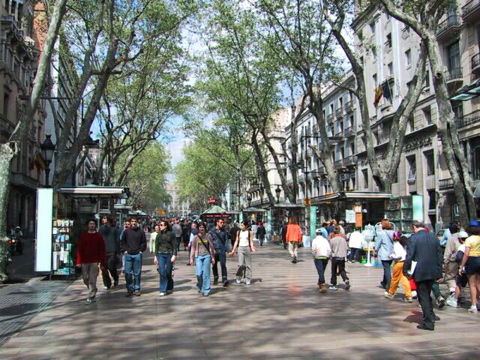
Worst Part: considering the fact that there was such little excitment on the field, that description in the 'novel' could have been cut down a little. Though it may have been intentional to drag it out somewhat, time is of essence People! But for Orwell and the men in the trenches, time was their worst enemy.
Recommend to: A great way of introducing a subject that is otherwise left unsaid in history class. Franco's war and rule is not considered to be a dictator because of the NUMBERS - numbers of deaths, number of soldiers, number of those involved. Though he killed as many for simply being liberal teachers - including J's own 1st grade teacher - he didn't kill enough for that 'honour'.
Cool Fact: Though considered to be a work of fiction by Orwell, the gentleman in question did in fact live in Barcelona at the time of the Civil War and did fight for the Loyalists. This is more of an eyewitness account then one would at first believe it to be.
Orwell's real name is Eric Blair. He wrote this as he was recooperating from his wound.
Tuesday, December 12, 2006
| [+/-] |
Olé-lé, Ola-la, Olé-lé, Ola-la |

Monday, November 27, 2006
| [+/-] |
A Short History of Myth |
Title: A Short History of Myth: (Myths)
Author: Karen Armstrong
Gendre: Religion, History
Series: Myth Series with Margaret Atwood, Jeanette Winterson, A, Y. Byatt, Donna Tartt & more!
ISBN: 0676974198
# of Pages: 159
Published: 2005; Alfred A Knoff Canada
Began & Finished Reading:
Sometime in November '05. Read it in one sitting... that kindof book.
Since Grade Three when my Mom came to school and dropped off my blue-framed glasses, I have been a blind bat. Close, far--doesn't matter. I was squinting all the time even with the lenses on. Last year when my doctor told me that my eyes were as dry as a prune, my father, in an act of charity decided to send me to IRIS & get my eyeballs zapped. Up until that point when they were cutting open my cornea, I was looking forward to the morning that I would awake without having to poke my eyeballs out. Alas, my first morning post-surgery was spent in bed, lying on my back wearing a huge pair of protective sunglasses, my eyes tearing up. The only form of entertainment I had were dreams (which can be fun & scary) & CBC radio. Boy did I learn a lot! One of the episodes was an interview with Margaret Atwood on her piece The Penelopiad; they went into some detail on the idea of myth and Armstrong's work. Well of course the first thing I did when getting out of bed was head to Chapters & buy books (now that I could read without glasses!!!) And since Atwood’s work didn't turn me on, so to say, I decided to pay the non-fiction world a visit and that’s how I ended up reading Armstrong's slim volume, The Short History of Myth.
The Gist: Armstrong's piece is a short overview of what a myth is and the various interpretations and presence it has had throughout World History. Her chapters are broken up in chronological order of time periods--from Paleolithic to Present--and she does examine the international scale and not solely Western myth. She examines the effects myth has on a populace as a whole more so than on a particular individual and how the myth & ideology supports many of the social, political and economic structures in place at the said time.
Comments: Already the idea of examining 'myth' on such a large scale level is ambiguous and it’s difficult even now to think of how she does it in 150-some pages! Fact is, she doesn't... Armstrong's work is a springboard if anything... a push in the right direction. She does have a list of references at the end which you can take up on any of the topics that interested you most. Overall, it’s a great addition to my library, but it’s not the know-all, have-all on mythology. I recommend the book Mythology by C. Scott Littleton (ISBN: 184480616). Many of Armstrong's points help with the interpretation of myths while reading them and understanding how they function on several levels.
Best Part: One unique element in this book is that throughout the work, Armstrong examines root words & the evolution of their meaning.
"Today the word 'myth' is often used to describe something that is simply not true. A politician accused of a peccadillo will say that it is a 'myth', that it never happened. [...] But in the pre-modern world, when people wrote about the past they were more concerned with what an event meant. A myth was an event which , in some sense, had happened once, but which also happened all the time."
Also, you can see her language is simple but appropriate unlike those business books you read that make you feel like a high school drop out the grammar and vocabulary is so, "I see Jane. Jane sees me."
Worst Part: She integrates historical aspects well but there is a lack of STORY. It would be nice if there were brief examples of myths themselves. The omission is understandable, I guess, considering the size but since when was there a maximum number of pages for a book? I think if she would have made it 60 pages longer and include some actual myths it would have enriched her text considerably.
Recommend To: A teacher to include on a summer reading list ACCOMPANIED by a myth. I can see how this can be a constructive tool for younger students to apply in essay writing in the future--a skill it seems the education system is not addressing correctly considering the number of students that do not understand that a thesis is NOT an introduction. Armstrong organizes and clearly explains her ideas in a way that could stand to be emulated.
Cool Fact: Armstrong was a Nun, who during her time living in a convent went to Oxford University during the day. She left the order during her school years and when her Doctoral thesis was rejected by the panel, she went her own way. Armstrong’s biography, The Spiral Staircase: My Climb Out of Darkness


Saturday, November 25, 2006
| [+/-] |
Obasan |
Title: Obasan
Author: Joy Kogawa
Genre: Historical Fiction
ISBN: 9780143055020
# of Pages: 228
Published: 1981, Penguin group Canada
Began Reading Nov. 16th, '06
Finished Reading: Nov.21st, '06
It is always dangerous for me to walk into Chapters. The smell of books fresh off the press, the sound of pages being flipped as a potential courtier peruses the contents, the Pine Sol brilliance of the shelves... Walking down the aisles, I reach out my hand and caress the covers as if it is the silky skin of my lovers. My roommate, used to the blank expression on my face, reminds me of the humongous pile of unread books on my nightstand and the even larger pile that has no shelf, for there is no room. But her voice is more like a bee buzzing by my ear than a siren of warning. 'I need it. I want it.'” Overcome with desire, I give in every time. At home, I introduce them to the family, "Chekhov. Melville. Meet your new neighbor." I may not start reading it that night or that year. But I will read it eventually. And buy more.
Thats how Obasan fell into my hands.
The Cheese: "Everyone someday dies," Obasan keeps on repeating to her niece Naomi. As Naomi stares at her aged aunt whose aura of silence has always baffled her, she recalls the course of events that brought her family from their happy home on the B.C. coast to the Alberta prairies. Covering the startling and shocking treatment of Japanese-Canadians during WWII, the reader is introduced to a Canada never seen before. Racist, apathetic, and selfish the country drives their citizens through starvation, the robbery of loved ones & possessions, and death. Naomi is our narrator and tells in her bitter, eloquent voice how even with all the suffering & bad blood she is Canadian and her country's actions are her cross to bear along with the others.
Comments:Powerful in language. Her lyrical tone reminds me of a sad ballad one may hear on an oldies radio station. What sets this work apart is the use of SILENCE at the times when normally there would have been dialogue. The way the story unfolds features is complex & is time sensitive - something one realizes only upon reflection. These characters, whose cyclical lives feel so much like our own, are each trying to cope with the unexpected. My only regret is that I did not choose this as the monthly B. Club read--the imagery, style & powerful metaphors all call for open panel discussion. Too complex & too many for one mind in one read to fully comprehend &/or appreciate.
Best Part: 'Once a widower father of one of the boys in my class came to see me after school and took me to dinner at the local hotel. I felt nervous walking into the Cecil Inn with him.
' "Where do you come from?" he asked, as we sat down at the small table in a corner. That's the one sure-fire question I always get from strangers. People assume when they meet me I'm a foreigner.' Page 11
Whenever that question comes up, it’s always followed with a long pause and then an even longer explanation, and I am never sure quite what the inquiry means. Being a third generation WOP-Canuk myself, which am I? Both Italian and Canadian because I have both passports? Canadian because I was born here? Italian because I still make sausage and wine in my Nonnina's candina? Is this question only ambiguous for Canadians? Perhaps this lack of self-identity grounded in nationhood is a reason why Canadian identity is such a troubling, ambiguous issue. However confusing it may be for me and others of different cultural heritage, the issue was all the more confused for the characters in Obasan, especially during that period in Japanese-Canadian history.
Recommend To: Those that appreciate a writer’s twist in language, in a bitter-sarcastic way. Best example being Chapter 38, an Ode to her Mother that in terms of prose rings of the Hail Mary. All those who love accurate historical fiction will also enjoy this read.
Not For: The impatient reader. Going on a trip to Vancouver--you don't want to bring this along. Trust me, it’s not about the scenery. (if you are then Stanley Park is much better suited for that ;)
Awards Won:


Book of the Year Award - Canadian Authors Association
Best Paperback Fiction Award - Periodical Distributors of Canada
The American Book Award - Before Columbus Foundation
Cool Stuff: For anyone that wishes to use this book in a group or classroom there is a great community website that gives guides, bibliography for further research, and author history. Go here .
Another fellow Book Blogger beat me to a Review!!! Check out what she had to say by clicking on her link to the right 'Les Book Nook'. It’s always recommended to get a second opinion...
Tuesday, November 21, 2006
| [+/-] |
Progress Report |
Turns out we have failed yet again my fellow huminoids!
Title: A Short History of Progress
By: Ronald Wright
ISBN: 0887847064 Page#: 132 + endnotes... & there are many!
Published: 2004 House of Anansi Press Inc.
Began Reading: November 13th Finished Reading: November 14th 2006
Da Jazz: Wright is trying to give us a general prediction about the future by investigating humanity's (depressing? sorry? pathetic? violent?...) past. His conclusions of course can be summed up in the fact that there is little hope that we can really recooperate. Not becauase its impossible or beyond our capability. Oh no! Just that historically it seems as if mankind is waaaaaaaaay to preoccupied with the NOW! in every sense of the word. A little too much Niezche education there guys! Wright examines the development of tools, the 'progress' of civilization, development of hierarchy... You know, the usual.
Recommend to: A great intro to fiction readers to join the other side. Those looking for a present of general interest. Dad & Harry I think would love this especially the former.
Not For: Anthropology student. Way too 'been there done that'. Wright isn't bringing anything new to the table. Rather it's in his style and the WAY he presents the old hat material that makes this book worth while.


